
The Open Rivers Programme offers grants to support projects that lead to the removal of small dams and the restoration of rivers and their biodiversity.
Around a million dams that fragment rivers have been counted in Europe, and there is great potential and need to remove obsolete dams. Dams are contributing to a significant decline in biodiversity and their removal can effectively restore longitudinal continuity, restoring the natural flow of the river and its biodiversity. Furthermore, in our society there is a significant lack of understanding about the benefits of dam removal and only a few public administrations and a handful of organizations promote and finance it at a European level.
In recognition of the scale of the problem, a significant funding gap and also the opportunity, Arcadia reconoció la escala del problema, la existencia de una significativa brecha de financiación y también la oportunidad, por lo que llevó a cabo la creación del Open Rivers Programme en la primavera de 2021. Así, el 25 de junio de ese año se formó en los Países Bajos la nueva entidad «Stichting European Open Rivers Programme» para gestionar e implementar el Open Rivers Programmes, que a través del cual ofrece subvenciones para eliminar pequeñas presas y restaurar ríos europeos en peligro.

El Open Rivers Programme comenzó a operar oficialmente en octubre de 2021, con fondos de Arcadia, un fondo de caridad de Lisbet Rausing y Peter Baldwin that supports work to preserve cultural heritage, protect endangered ecosystems and promote access to knowledge. Its goal is to defend the complexity of human culture and the natural world, so that the next generations can build a vibrant, resilient and green future.
CIREF and Open Rivers Programme
CIREF reconoció en este programa una estupenda oportunidad para continuar con el trabajo que lleva a cabo para la recuperación del buen estado de los ecosistemas fluviales de la península ibérica. Además, Open Rivers Programme facilita a organizaciones como CIREF la posibilidad llevar a cabo su labor de fomento de la gobernanza fluvial mediante la implicación de organizaciones no gubernamentales en su restauración, así como una excelente ocasión para para continuar difundiendo los conceptos de restauración fluvial que la asociación defiende y difunde.
Así, en 2022 CIREF presentó dos proyectos para la eliminación de dos presas situadas en la cabecera del río Ega (Navarra), que han sido financiados por Open Rivers Programme para su ejecución durante el año 2023.
El primero de los proyectos es el de la Presa del Molino de Zúñiga (o Molino de Arquijas). Este proyecto está enmarcado en la categoría A2 del programa Open Rivers Programme, que financia el desarrollo trabajos preparatorios necesarios para la eliminación de presas. La cantidad concedida es de 22.220€ que cubrirán los costes de la elaboración del documento técnico (proyecto ejecutivo) para la eliminación de la presa, del proceso de participación ciudadana y de la tramitación de los permisos necesarios para poder iniciar las obras. Una vez toda esta documentación esté lista, CIREF presentará una nueva propuesta a la convocatoria Open Rivers Programme en la categoría A3 (eliminación de presas con proyectos ya redactados) para acometer su eliminación.
El segundo de los proyectos es el de la presa del Molino de Gastiáin, situada 4,9Km aguas abajo de la anterior. Este proyecto pertenece a la categoría A3, que financia la ejecución de las obras de eliminación de presas cuyo proyecto ya ha sido redactado y financiado previamente. En este caso, el Gobierno de Navarra ya había redactado el proyecto de eliminación de la presa y llegó a un acuerdo con CIREF para que la asociación se hiciera cargo de la ejecución de las obras. La cantidad que Open Rivers Programme ha concedido a CIREF para este proyecto es de 168.486€, que permitirán que la asociación pueda llevar a cabo la ejecución de las obras y su dirección, el proceso de participación ciudadana, una campaña de comunicación sobre la eliminación de obstáculos y la monitorización durante el primer año (pre y post ejecución) de los efectos que la demolición de la presa tiene sobre aspectos tales como el transporte de sedimentos, el hábitat piscícola y las comunidades de peces e invertebrados.
Project area and its ecological values
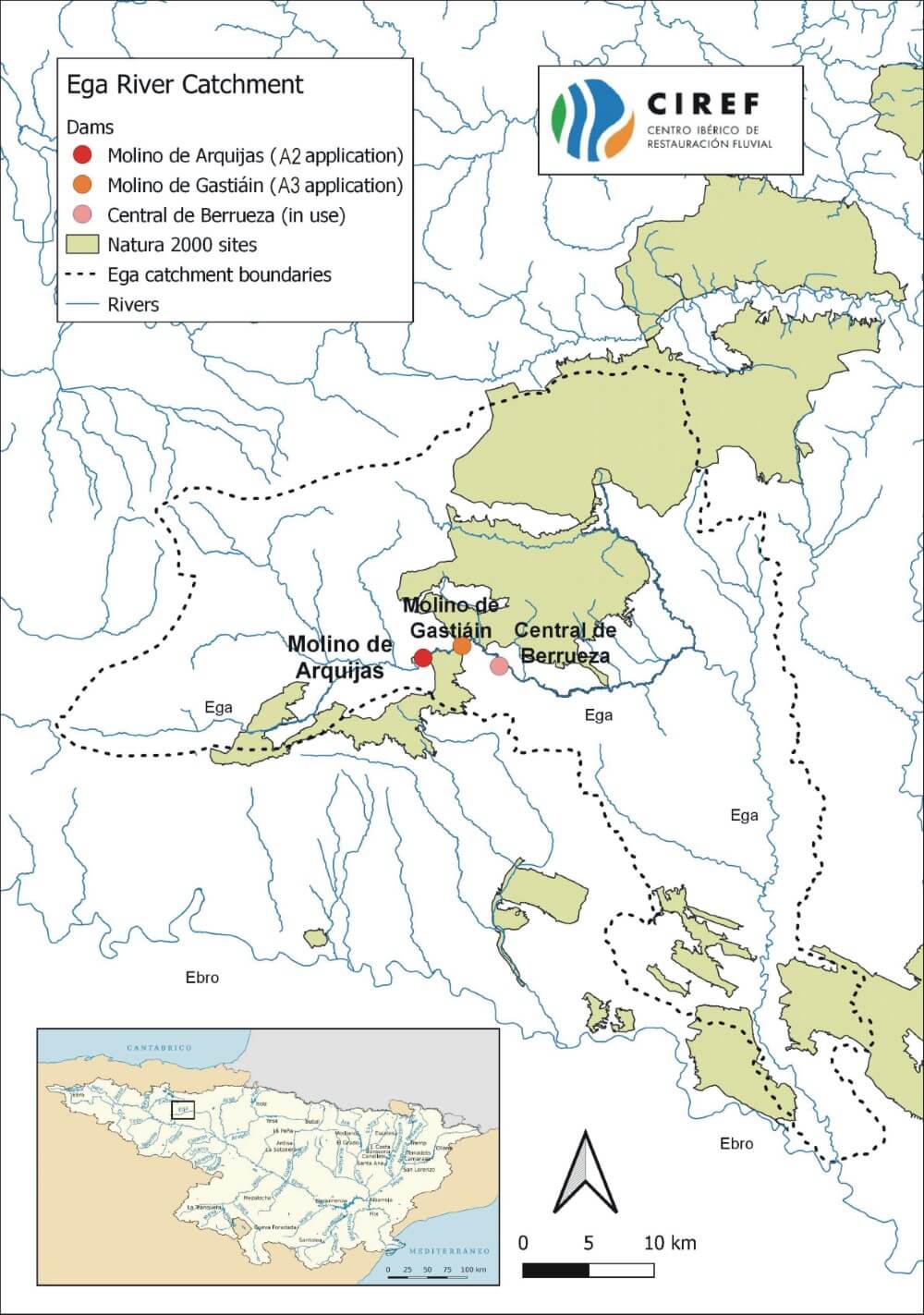
The two dams are located in the upper part of the Ega river basin, a tributary of the Ebro on its left bank as it flows through the Region of Navarra.

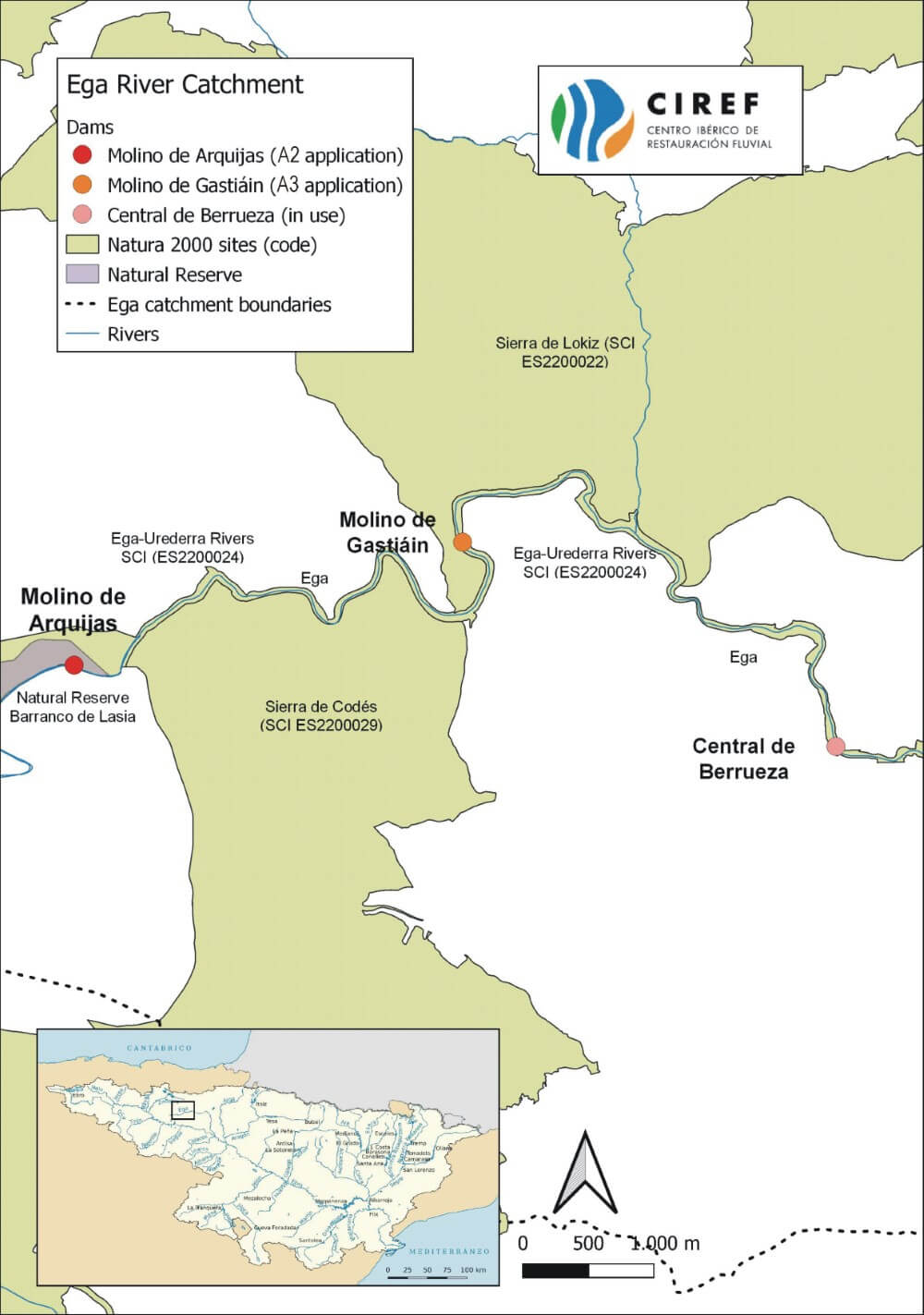
The Molino de Arquijas dam (also known as Molino de Zúñiga) is located in a natural environment of great ecological relevance, declared a Nature Reserve and Special Conservation Area (SAC) of the Natura 2000 network by the Government of Navarra, in the Ega river basin. This 3.5m high dam is the closest dam to the headwaters of the Ega river. 4.9 km downstream of this dam, and located in the same Natura 2000 site, is the Molino de Gastiáindam, also 3.5m high.

The holistic approach proposed by CIREF, which includes the removal of the two dams, will free the entire upper part of the Ega River from obstacles and will help meeting the conservation objectives proposed for this Natura 2000 site. Since the Molino de Arquijas dam is the most upstream dam on the Ega River, its removal will free up the remaining 34.8 km upstream to its headwaters. 4.9 km downstream from this dam is the Molino de Gastiain dam, and 5 km downstream from the latter is the Berrueza dam, currently in use for irrigation. Therefore, when the Molino de Arquijas and Molino de Gastiáin dams are removed, the total distance of the river free of obstacles upstream of the Berrueza dam will be 44.7 km.
The recovery of fluvial continuity is essential for the conservation of the native fish species living in the headwaters of the Ega river. However, the two dams pose a major obstacle to the migration of fish, among which two potadromous species are considered as Key Elements for management in the SAC "Ríos Ega-Urederra" (ES2200024), because they are species included in Annex II of the Habitats Directive: Ebro nase (Parachondrostoma miegii) and Bermejuela (Achondrostoma arcasii).
 The Ebro nase is an Iberian endemism that is distributed mainly in the Ebro basin. It prefers habitats with moderate currents and stone and gravel substrates, but needs to migrate upstream towards the upper parts of the basin to spawn, which takes place in shallow waters with stone or gravel bottoms in the months of March to May. It feeds on benthic diatoms. Its populations have been reduced or have disappeared from many places due to the presence of obstacles and introduced species.
The bermejuela, for its part, is also endemic to the Iberian Peninsula and is distributed in most of the rivers in the North and Center of the peninsula, although with a very reduced current distribution, especially in Navarra, where it is only found in a few rivers, including the Ega. It prefers low flow mountain rivers and also needs to migrate upstream to spawn, between April and June. Juveniles occur in shallow areas with gentle currents, moving into deeper, faster waters in late July. Although its diet is opportunistic, it feeds mainly on aquatic invertebrates.
According to the latest Habitats Directive report on the article 17, the conservation status of these two species is "unfavourable-inadequate" and is deteriorating in the Mediterranean region. The main pressures described for both species are human-induced changes in hydraulic conditions (canalization and dams) and the presence of exotic species.
Indeed, in addition to the dams, the Ega River is also home to some exotic fish species that pose a threat to native species, since they take advantage of denatured river sections, such as the dammed areas upstream of the dams where they proliferate. Four exotic species of fish have been identified that compete with native fish in the Ega River: bleak (Alburnus alburnus), carp (Cyprinus carpio), gold fish (Carassius auratus) and rainbow trout (Oncorynchus mykiss) that use these dammed habitats.
Objectives of the project
The main objective of the project is to restore the longitudinal continuity in 45 km of the headwaters of the Ega River, a valuable river included in the Natura 2000 Network.
 The ecological status of the fish species that inhabit the upper reaches of the Ega River will improve with the removal of the two dams, since fish migrations towards the upper reaches will be favoured, which is of great importance to ensure the survival of the eggs and juveniles of these species. Spawning in lower reaches increases the likelihood of mortality caused by flooding, higher water temperatures, and predation (especially by exotic fish), so the strategy of native fish species is to migrate upstream to areas where their fry have more chances to survive. The genetic exchange between individuals along the river, the colonization of new territories and the greater availability of food are other reasons why migration is important for these species and the improvement of their conservation status. Therefore, the main reason for removing the dams is to regain access for fish to high-quality spawning grounds upstream, thereby increasing their reproductive success and thus the conservation status of these target species.
 Restoring the river's natural habitats is also an important reason for removing the two dams. The fish habitat upstream of each of these two dams is not appropriate for the native fish species (adapted to rapid, shallow and cold waters), since they retain water for 1 km upstream of each dam. Instead, the deep, slow-moving, and poorly oxygenated waters dammed up by the action of the dams offer favourable conditions for exotic fish species that proliferate and compete with native fish, some of which even prey on them (rainbow trout). The removal of the dams will also restore the natural succession of pools and riffles, creating an unfavourable habitat for exotic species and favouring the increase of native fish populations.
On the other hand, the elimination of the dams will favour not only the free flow of water, but also that of the sediments that are currently deposited in the dammed section, which will reactivate the natural fluvial dynamics, an important aspect in the restoration of any river system.
CIREF has designed a monitoring plan that will make it possible to establish the situations before and after the demolition of the dams for the indicators mentioned in the previous paragraphs, serving as the basis for possible future monitoring in the longer term. This plan also aims to be able to evaluate the improvement of the river ecosystem in response to the removal of dams, thus making it possible for citizens to understand this kind of actions.
As for the social benefits, the area is frequented by hikers and anglers who will see how the natural environment will benefit from the removal of the dam, since the river habitats will be diversified. In addition, the positive impact that the demolition of the dams will have on native fish species, such as brown trout, will benefit fishermen. By releasing the water retained upstream of the dam, the quality of the water will also improve, especially with regard to its oxygenation and self-purification capacity, so that the water intakes located downstream will also benefit. Regarding flood prevention, the demolition of the dams would avoid the possible damage that could occur if the dams (in poor condition) were to break due to a flood event.
It is also planned to carry out an information campaign targeting all interested parties that can influence these social aspects so that citizens can appreciate the value of removing obstacles and restoring river ecosystems. The involvement of all interested agents in the projects will make it possible to publicize the relevance of dam removal projects, the ecological values of the Ega River and the need to preserve and restore river ecosystems.
Finally, it is necessary to indicate that this project has many possibilities of being replicated in other places, since in the Iberian Peninsula there are hundreds of similar cases. CIREF will make a great effort to publicize the project and its results so that it can be replicated in other places, as a way of improving fluvial governance in the Iberian Peninsula through the joint work of NGOs with the competent authorities (environmental, hydrographic confederations and local authorities) and civil society.
Context and opportunity

The mills built in the Ega river were used for centuries to grind the cereal that is produced in the area. However, with the modernization of the agricultural sector, the mills became obsolete and little by little they were abandoned. Now only the remains of the old buildings and the dams that were used to divert the water remain standing. In both, Arquijas and Gastiáin mills, the dams are in poor condition due to lack of maintenance after the activity was abandoned, which poses a danger to crops, goods and people located downstream, since their rupture could cause serious damage.
Neither of the two dams is currently in use and there are no other legal issues that could prevent the dams from being removed. In fact, the competent authorities have agreed to its demolition in application of the Spanish Water Law and to avoid possible damage caused in case of floods. The Government of Navarra wishes to eliminate the obstacles out of use that interrupt the fluvial continuity as a way of ecological improvement of the fluvial systems in the region, continuing with the successful experiences verified in other basins, in which the removal of obstacles is facilitating the recovery of emblematic species, such as salmon in the Bidasoa river basin. Moreover, in the case of the Arquijas dam, the Ebro Hydrographic Confederation (CHE) has required the private owners to remove the dam. The private owners have reached an agreement with CIREF so that the association is in charge of drafting the project and subsequently removing the obstacle. In the case of the Gastiáin dam, the ownership of the dam is unknown, so CIREF has agreed with the CHE, the Government of Navarra and the local authority, that the association take charge of removing the dam.
The elimination of both dams will also facilitate the achievement of the objectives of various plans and regulations adopted for the Ega basin. On the one hand, the Management Plan for the Natura 2000 SAC "Ríos Ega-Urederra" (ES2200024), which proposes "to improve the habitat conditions of the native fish community"; on the other, the Ebro Basin Plan, which contemplates the elimination of unsued dams to meet the objectives of the WFD; on the other, the Spanish National River Restoration Strategy, which also promotes the elimination of unused dams and, finally, the European Biodiversity Strategy 2030, which aims to reach the figure of 25,000 km of rivers free flowing rivers by that date.
Therefore, it is evident the need to eliminate the infrastructures that interrupt the fluvial continuity and to recover the natural dynamics of the Ega river at its headwaters.


